

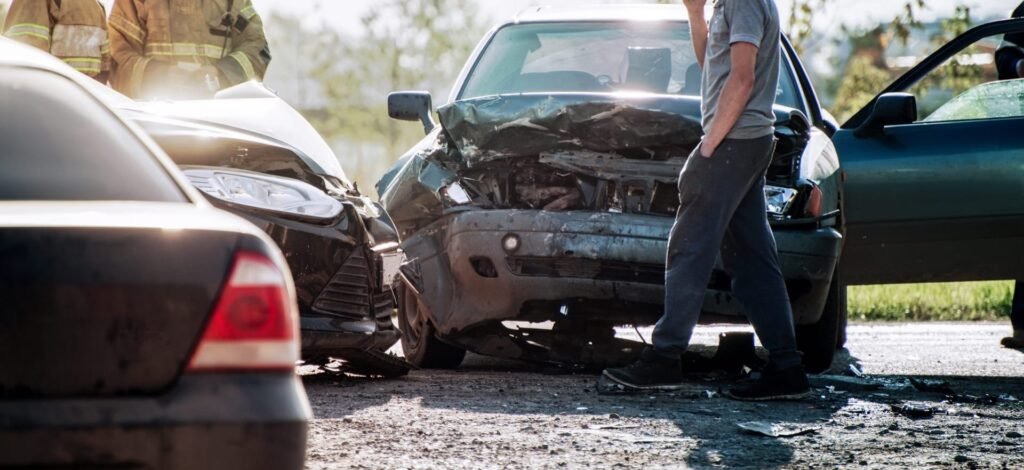
On ice or snow, the driver who loses control is usually the one at fault, because the Highway Code expects every driver to slow down and leave far more room in winter, so “it was icy” is rarely accepted as a defence. If another driver slid into you, hit you from behind or crossed onto your side of the road, the claim goes against their insurer, and National Accident Support Line can handle the claim for your car against the driver who skidded into you, with a like-for-like hire car while yours is repaired.
Winter crashes follow familiar patterns: someone brakes too late and slides into the queue, a car takes a bend too fast and drifts over the white line, and afterwards the driver says it was black ice and nobody’s fault. This guide covers when that argument works, when blame is shared, where the council comes in, and what to record at the scene while it’s still icy.
No excess to pay if the accident wasn’t your fault. Fill in our form and we’ll call you back within 2 minutes.
Why “it was icy” is rarely a defence
Ice and snow are conditions to drive for, not an excuse. The Highway Code says not to drive in icy or snowy weather unless you really have to (rule 228), to keep well back from the vehicle in front because stopping distances can be ten times greater than on dry roads (rule 230), and to drive slowly in as high a gear as possible, braking and accelerating gently (rule 231). Rule 126 says the same about following distance: the gap should be up to ten times greater on icy roads.
Most of those rules are advice rather than law, but under section 38(7) of the Road Traffic Act 1988 a breach of any of them can be used to establish liability. So the question after a slide isn’t whether the road was slippery, but whether the driver allowed for it.
The courts have said a car shouldn’t go into a skid without a good explanation, so the driver who skidded has to give one. The explanation that occasionally works is ice that genuinely couldn’t have been seen or expected: in one Court of Appeal case, a driver who hit invisible black ice at a sensible speed, with no reason to expect ice that day, was found not negligent. That’s the exception. On a frosty morning with gritters out, drivers are expected to assume there’s ice.
When the other driver is at fault on ice or snow
These are the usual starting points. Each can move if the evidence shows you made a mistake too.
| What happened | Who is usually at fault |
|---|---|
| A car slid into the back of yours at lights, a junction or in queuing traffic | The driver behind, who should have left a far bigger gap and braked much earlier |
| A car slid through a give way or stop line into you | The emerging driver, who should have approached slowly enough to stop at the line |
| A car slid across the centre line into you, often on a bend | The driver who crossed over, who should have slowed before the bend (rule 231) |
| A car overtook in snow or on ice and hit you | The overtaking driver. Overtaking on ice, or passing a snowplough on an uncleared lane, is hard to justify (rule 230) |
| A parked car slid down an icy hill into yours | Usually the driver who parked it: handbrake on firmly, in gear, wheels turned the right way for the slope (rule 252) |
| Snow or ice flew off another vehicle’s roof and hit your car | The driver who didn’t clear it, if the vehicle can be identified (rule 229) |
| Two cars slid into each other at a junction where neither could stop | Often shared, depending on speed and who had priority |
For the dry-road equivalents, see our guide to how fault is settled in everyday collisions.
Shared fault and contributory negligence
Being partly to blame doesn’t stop a claim. Under the Law Reform (Contributory Negligence) Act 1945, what you recover is reduced by your share. On ice, insurers look at the non-fault driver too: were you also too fast for the conditions, could you have stopped or steered away, were your windows and lights clear, were your tyres legal? Winter tyres aren’t a legal requirement in the UK, but tread below 1.6mm is an offence and an easy point for the other side.
If your insurer suggests 50/50 “because it was icy”, ask what evidence it’s relying on before you agree. The weather was the same for both drivers, so on its own it doesn’t move blame from one to the other.
Black ice and council gritting
Under section 41(1A) of the Highways Act 1980, councils must ensure, so far as is reasonably practicable, that safe passage along a highway isn’t endangered by snow or ice. The limit is written into the duty itself. A council doesn’t have to grit every road, and it defends these claims by showing it did what was reasonably practicable, usually with a winter service plan, priority routes and gritting decisions based on the forecast. Many side roads are never on the plan.
Council ice claims do sometimes succeed. In one case a council that ignored police requests to grit a road where several cars had come off the evening before was held two-thirds to blame, with the driver one-third. But they’re harder and slower than a claim against another driver. In Scotland the duty comes from different legislation.
To be plain about what this means for a claim with us: a claim against a highway authority is a different route from a claim against another driver’s insurer. Our replacement vehicle service is for claims against the insurer of a driver who caused the accident. If you skidded on an ungritted road and nobody else was involved, a credit hire car isn’t available, and your own policy is the place to start. If you were injured, tell us what happened and we’ll say whether it’s a claim we can refer.
Clearing snow off the car, and how it affects fault
Rule 229 says that before you set off you must be able to see, so snow and ice must be cleared from every window, and lights and number plates must be clean and readable. Those parts are law. The rule also says to clear the mirrors and remove any snow that might fall off into the path of other road users. Snow left on the roof isn’t an offence on its own, but police can act where a vehicle is used in a dangerous condition.
It cuts both ways. A driver peering through a gap in a frosted windscreen who hits you has handed your claim a strong point. Snow sliding off a van roof onto your windscreen is a claim against that driver’s insurer, if you get the registration. And if your own windows, lights or plates were covered, expect the other side to argue you share the blame.
No excess to pay if the accident wasn’t your fault. Fill in our form and we’ll call you back within 2 minutes.
What to do at the scene in winter
Get everyone out of the road first: other cars can slide into the scene, so put the hazards on and stand on the verge, not between the cars. Call 999 if anyone is hurt or the road is blocked. Exchange names, addresses, registrations and insurers. If you can’t, or someone was injured and insurance details weren’t shown, report it to the police as soon as reasonably practicable and within 24 hours.
Then record what decides winter claims, before the ice melts or the gritter arrives:
- the road surface, in photos and a short video, and whether it had been gritted
- the other car’s windows, lights and roof, if they weren’t cleared
- your own cleared windscreen, lights and plates
- the time, the light and the outside temperature on your dashboard
- other cars that slid at the same spot, and anyone who saw it
- your dashcam footage, saved before it records over
If the driver who slid into you didn’t stop, a hit and run has its own route through the Motor Insurers’ Bureau. Tell your own insurer about the accident, even if you won’t claim on your policy.
If it wasn’t your fault: a like-for-like hire car while yours is repaired
Winter is a bad time to lose a car. If another driver caused the accident, a replacement equivalent to yours is a cost of the accident, recovered from their insurer, for as long as you need it while your car is repaired or, on a write-off, until the settlement is paid. Like-for-like means the same size and class, the same number of seats, an automatic if yours is one, and four-wheel drive if that’s what you drive, as close as availability allows.
We confirm the accident wasn’t your fault before a vehicle is delivered, and we aim to replace non-drivable vehicles within 48 hours. The hire is arranged through credit hire, which is a credit agreement, so read it before you sign: ask what you’d owe if liability were disputed and whether there’s an excess if the hire car is damaged, and expect to pay for your own fuel and any fines. There’s more on our like-for-like hire car service, and if the other insurer blames the ice, our in-house recovery team argues liability with them on the evidence.
Situations people describe to us
“The car behind slid into me at the lights and says it was black ice”
The clearest winter claim there is: if the road was icy enough to slide on, it was icy enough to leave a bigger gap. Send us your photos and footage.
“A car slid down the hill into my parked car overnight”
Get its registration, photograph where it ended up and ask neighbours about doorbell footage. The claim is usually against the insurer of the car that slid.
“I skidded on black ice and nobody else was involved”
There’s no other driver’s insurer to claim from, so this isn’t a credit hire case, and your own policy decides what’s covered. If you think the council failed to grit, keep your photos and note the date, time and place.
Frequently asked questions
Who is at fault if a car slides on ice and hits you?
Usually the driver who slid. Drivers are expected to slow down and leave far more room on icy roads, so losing control is normally treated as their fault, not the weather’s.
Can a driver blame black ice for an accident?
They can try, but it rarely works. It succeeds only where the ice couldn’t have been seen or expected and the driver was at a sensible speed. On a frosty day, ice is something drivers are expected to anticipate.
Is the driver behind always at fault in icy conditions?
Almost always. The Highway Code says the gap should be up to ten times greater on icy roads, so a driver who slides into the car in front was usually too close or too fast.
Can I claim against the council for not gritting the road?
Sometimes, but it’s a separate claim against the council, not another driver’s insurer. The council only has to do what is reasonably practicable, and it usually defends by showing it followed its winter plan.
Does an accident on ice affect my no-claims discount?
If the other driver was at fault and their insurer pays your costs, it shouldn’t. If liability is split, it usually counts as a fault claim on your record.
Can I get a hire car after an accident on ice that wasn’t my fault?
Yes, if you need one. A like-for-like replacement can be provided while your car is repaired, with the hire charges claimed from the at-fault driver’s insurer.
No excess to pay if the accident wasn’t your fault. Fill in our form and we’ll call you back within 2 minutes.