
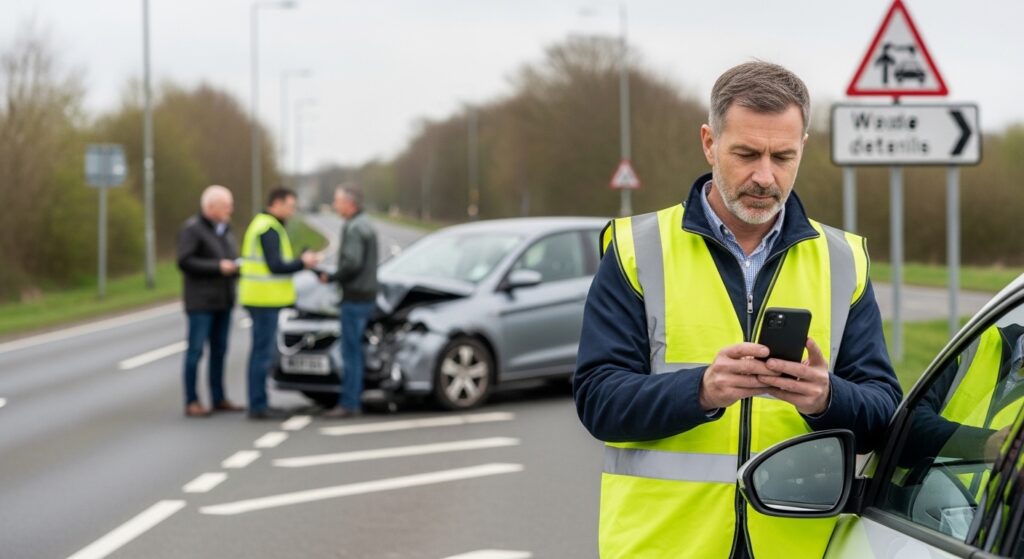
A car accident is stressful and disorienting. In those critical first moments, it’s easy to panic or make decisions you’ll later regret. However, knowing exactly what to do immediately after an accident can protect your safety, preserve evidence, and safeguard your legal rights.
This comprehensive checklist covers everything you need to do right after a collision in the UK — from ensuring everyone is safe to gathering essential information for your insurance claim and potential legal case.
1. Check for Injuries and Move to Safety
Your immediate priority is safety — not the vehicles.
- Check yourself and passengers. Look for injuries, however minor they may seem. Some injuries (like whiplash) develop hours after impact.
- Activate hazard lights immediately to warn other road users.
- If possible and safe, move vehicles out of traffic to the roadside or a safe location. Leave them in neutral with the handbrake engaged.
- Turn off engines to reduce fire risk.
- If anyone is seriously injured, call 999 immediately. Do not move injured people unless there’s immediate danger (fire, oncoming traffic).
- Wear a high-visibility vest if you exit your vehicle on a busy road.
Why this matters: Moving to safety prevents secondary accidents. Even minor-looking injuries can worsen over time, and medical records created immediately strengthen any compensation claim.
2. Call the Police (If Required)
You must call the police in these situations:
- Anyone is injured or seriously hurt
- There’s significant damage to vehicles or property
- Another driver refuses to provide details
- You suspect the other driver is under the influence of drugs or alcohol
- A hit-and-run situation occurs
- The accident is blocking traffic
For minor collisions with minor damage and no injuries:
Police attendance is optional, but you can still call them if you wish. However, you must report the accident to your insurer regardless.
What to do:
- Call 101 (non-emergency) or 999 (if injury/danger)
- Provide clear location details
- Stay calm and answer questions accurately
- Request a police incident reference number for your records
- Ask for the attending officer’s name and collar number
Why this matters: A police report creates an official record and provides a reference number essential for your insurance claim.
3. Gather Information from the Other Driver
Do NOT admit fault or apologize for the accident. Even saying “sorry” can be interpreted as admitting liability.
Collect these details from the other driver(s):
- Full name and address
- Phone number and email address
- Date of birth
- Insurance company name and policy number
- Vehicle registration number
- Vehicle make, model, and color
- Driver’s license number
- Employer’s name and address (if relevant)
If the other driver refuses to provide details:
- Note their vehicle registration number
- Take photos of their car and license plate
- Call the police (101 or 999)
- Do not engage in confrontation
Why this matters: This information is essential for your insurance claim and any potential legal action. Without it, you’ll struggle to recover compensation.
4. Document the Scene Thoroughly
Take comprehensive photos and videos of the accident scene. This evidence is crucial for insurance claims and legal proceedings.
Photograph:
- Both vehicles: From multiple angles, showing damage to all sides
- Vehicle positions: How they’re positioned relative to each other
- The road: Lane markings, traffic signals, weather conditions, visibility
- Debris: Any scattered parts, glass, or road markings
- Traffic signs: Speed limits, junction signs, any relevant signage
- Road conditions: Wet, dry, icy, pothole damage
- Your injuries: If visible (bruises, cuts, etc.)
- Witnesses: Get photos of them and their contact details
Video evidence:
- Record a 360-degree walk-around of both vehicles
- Narrate what you’re seeing (conditions, damage, location)
- This provides context that still photos cannot
Why this matters: Photos and video are objective evidence. Insurance companies and solicitors rely heavily on visual documentation to assess liability and damage.
5. Obtain Witness Details
Witnesses are invaluable. Their independent accounts can support your version of events.
For each witness, record:
- Full name and contact number
- Email address
- Home address
- What they saw (brief summary)
- Their relationship to either party (if any)
Request permission to photograph or video record their statement if possible.
Why this matters: Witnesses provide impartial evidence. Insurance companies and courts value third-party accounts. Without witness details, you may struggle to prove liability if the other driver disputes their account.
6. Note the Accident Details
While the incident is fresh in your mind, write down:
- Date, time, and exact location (including road name and junction)
- Weather conditions (rain, fog, ice, etc.)
- Road conditions (wet, dry, potholes, debris)
- Traffic light status and any relevant road signs
- Speed you were traveling
- The other vehicle’s actions (sudden stop, failure to signal, etc.)
- Your exact vehicle position and direction of travel
- Any skid marks or impact damage patterns
- Injuries experienced (even minor ones)
- What you were doing immediately before impact
Be factual, not interpretive. Write what you observed, not what you think happened.
Why this matters: Details fade from memory quickly. Written notes created immediately after the accident are more credible than recollections made weeks later. They’re admissible as evidence in legal proceedings.
7. Don’t Accept Cash Settlements
Never settle the accident informally with cash from the other driver, even if they offer.
Why this is dangerous:
- You won’t have official documentation
- You can’t make an insurance claim later
- If injuries develop, you have no proof of who caused the accident
- The other driver may dispute what was agreed
- You’ve no protection if repair costs exceed what was paid
The only exception: If the other driver pays through insurance with proper documentation.
Why this matters: Informal cash settlements leave you completely unprotected legally and financially.
8. Contact Your Insurance Company
Inform your insurer as soon as possible — most policies require notification within a specific timeframe (often 30 days, but check yours).
Tell your insurer:
- Date, time, and location of the accident
- The other party’s details and insurance information
- A factual description of how the accident happened
- That you were not at fault (if applicable)
- Witness details
- The incident/police reference number (if police attended)
Important points:
- Stick to facts; don’t speculate
- Don’t admit fault
- Don’t discuss the accident on social media
- Keep copies of all correspondence
What your insurer will do:
- Assess your claim
- Arrange repairs or provide a settlement
- Potentially pursue a recovery claim against the other driver’s insurer
Why this matters: Prompt notification protects your claim. Delays can invalidate your policy or result in a reduced settlement.
9. Seek Medical Attention
Even if you feel fine, see a doctor or visit A&E if the accident was significant.
Why this is critical:
- Some injuries (whiplash, internal injuries, concussion) aren’t immediately apparent
- Medical records create a documented link between the accident and your injuries
- You’ll need medical evidence for a personal injury claim
- Delayed treatment can weaken your compensation claim
Visit your GP or A&E if you have:
- Neck or back pain
- Headaches
- Dizziness or vision problems
- Chest pain
- Numbness or tingling
- Any visible injuries
Keep all medical records and share them with your solicitor and insurer.
Why this matters: Medical evidence is essential for proving injuries and securing compensation for pain, suffering, and lost earnings.
10. Keep All Receipts and Records
From this point forward, retain everything related to the accident:
- Medical receipts and prescriptions
- Repair quotes and invoices
- Prescription costs
- Travel expenses to medical appointments
- Lost wages documentation
- Photographs
- Police and insurance correspondence
- Witness statements
- Repair shop invoices
- Car rental receipts (if needed while your car is repaired)
Organize these in a folder (physical or digital). You’ll need them if you pursue a compensation claim.
Why this matters: Documentation proves the financial impact of the accident. Without receipts, you can’t claim for these costs.
11. Don’t Post About the Accident on Social Media
This is crucial: Do not post about the accident on Facebook, Instagram, Twitter, or any social media platform.
Why this is dangerous:
- Anything you post can be used against you
- You might inadvertently admit fault
- Photos can be taken out of context
- The other party’s insurer monitors social media
- Posts can’t be deleted if they’ve been shared or screenshotted
Even seemingly innocent posts can damage your claim — e.g., a photo of you out with friends might be used to argue your injuries aren’t serious.
Why this matters: Social media evidence is frequently used in legal proceedings to undermine claims.
12. Consider Legal Representation
If injuries are significant or liability is disputed, consult a solicitor.
You should consider legal representation if:
- You’ve suffered injuries requiring medical treatment
- The other driver disputes liability
- Significant property damage occurred
- Your claim exceeds £1,000
- The other party is uninsured or untraced
- Your insurer is slow to respond
Many solicitors offer:
- Free initial consultations
- “No win, no fee” arrangements (Conditional Fee Agreements)
- Guidance on valuing your claim
- Negotiation with the other insurer
- Court representation if needed
Why this matters: A solicitor protects your rights and ensures you receive fair compensation for injuries and losses.
13. Understand Your Rights
In the UK, you have legal rights if another driver caused the accident:
- Right to compensation for injuries (pain and suffering)
- Right to recover losses (repair costs, lost wages, travel expenses)
- Right to legal representation at no upfront cost
- Right to reject low offers and pursue court action
- Right to claim against an uninsured driver through the Motor Insurer’s Bureau (MIB)
If you’re found partially at fault:
- You can still claim, but compensation is reduced proportionally
- A 30% fault finding means a 30% reduction in your settlement
Why this matters: Understanding your rights ensures you’re not exploited by insurers offering inadequate settlements.
14. Report Hit-and-Run Accidents
If the other driver left the scene:
- Call 999 immediately — it’s a criminal offense
- Provide the vehicle registration number (if you noted it)
- Describe the other vehicle accurately
- Report to your insurer
- Contact the Motor Insurer’s Bureau (MIB) if the driver is untraced
The MIB can provide compensation if the at-fault driver is never identified or insured.
Why this matters: Hit-and-run is a serious crime. Official reporting protects you and may result in the driver being identified.
15. What NOT to Do After an Accident
Avoid these common mistakes:
- ❌ Don’t admit fault or apologize — it’s interpreted as liability
- ❌ Don’t accept verbal apologies as settlement
- ❌ Don’t sign anything you don’t fully understand
- ❌ Don’t leave the scene before exchanging details (unless seriously injured)
- ❌ Don’t discuss the accident with the other driver’s insurer without legal representation
- ❌ Don’t delay reporting to your insurer
- ❌ Don’t repair your vehicle before an insurer inspection (unless it’s a safety hazard)
- ❌ Don’t ignore medical symptoms even if they seem minor
- ❌ Don’t post on social media about the accident
- ❌ Don’t accept the first settlement offer without legal review
Why this matters: These mistakes commonly weaken claims and reduce compensation.
The Immediate Aftermath: A Quick Reference Checklist
Print this checklist and keep it in your car:
- Check for injuries; call 999 if needed
- Move to safety; activate hazard lights
- Call police (if required)
- Exchange details with other driver
- Gather witness information
- Take photos and video of the scene
- Note the accident details while fresh
- Call your insurance company
- Keep all receipts and records
- See a doctor for injuries
- Don’t post on social media
- Consider legal representation
- Don’t accept informal cash settlements
Conclusion
Being involved in a car accident is traumatic, but following this checklist protects your safety, evidence, and legal rights. The actions you take in the first hour often determine the success of your insurance claim and any potential compensation.
Key takeaway: Prioritize safety first, gather evidence second, and report third. Document everything, keep records, and don’t hesitate to seek legal advice if injuries are significant.
Need help with your accident claim? National Accident Support Line is here to guide you through the process. We connect you with experienced solicitors who work on a “no win, no fee” basis, ensuring your rights are protected.