

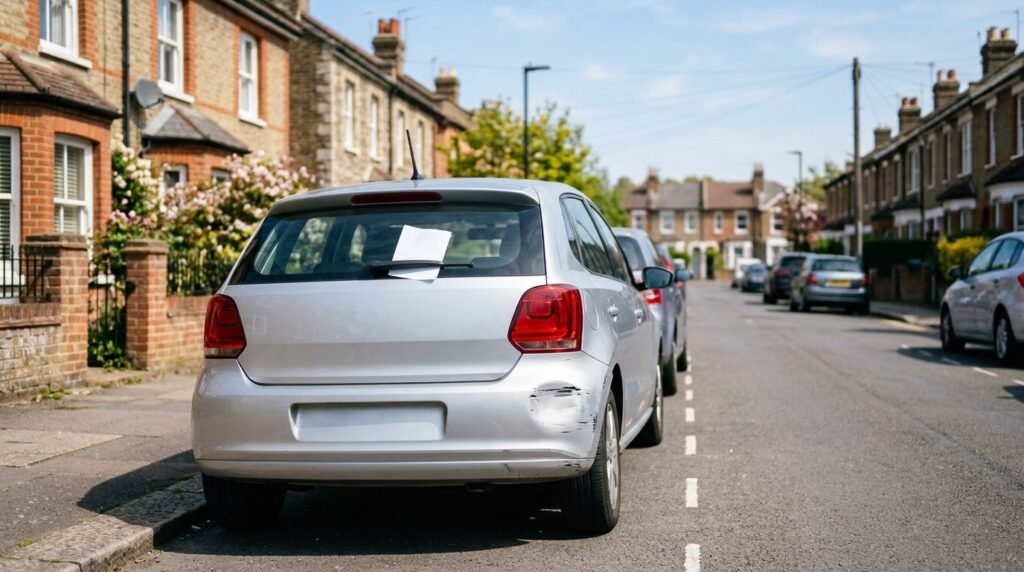
If your car was hit while it was parked, you’re almost never at fault, and the repair should be paid for by the insurer of the driver who hit it. What matters is identifying that driver: check for a note, photograph the damage, look for witnesses and cameras, and report it to the police if they drove off without leaving details. Once you know who it was, National Accident Support Line can take the claim to their insurer for you, so your own policy isn’t used, and arrange a replacement car that matches yours if yours is off the road.
It usually happens out of sight. You come back to the supermarket car park, or out of the house in the morning, and there’s a dent in the rear quarter and a scrape along the bumper. Sometimes there’s a note under the wiper. More often there’s nothing at all.
No excess to pay if the accident wasn’t your fault. Fill in our form and we’ll call you back within 2 minutes.
What to do when you find the damage
Do these on the day. Evidence goes quickly.
Check for a note. Look under the wipers, on the windscreen and in the door handle. If there is one, photograph it where you found it, then keep it.
Photograph everything. The damage close up and from a distance, the whole car, where it was parked, any paint transfer or debris on the ground, and the parking bay or road markings. Paint of a different colour in the scrape helps identify the other vehicle.
Look for witnesses and cameras. Ask anyone nearby, and leave your number with them. Car parks, shops, petrol stations and many homes have cameras, and other drivers’ dashcams may have caught it. Ask quickly, because many systems record over themselves within days. If your own dashcam has a parking mode, copy the file before it loops.
Report it to the police if the driver didn’t leave details. Note the reference number. Your insurer and the other driver’s insurer may both ask for it.
Who’s at fault when a parked car is hit
Almost always the driver who hit it. A parked car isn’t moving, so the driver of the moving vehicle is expected to have avoided it.
There are exceptions, and the other insurer may look for one. Parking where the Highway Code says you mustn’t, such as within 10 metres of a junction (rule 243) or in a dangerous position (rule 242), can lead to a share of the blame. So can parking on a road at night facing against the traffic (rule 248), or without parking lights where the speed limit is over 30mph (rule 249). Even then, the moving driver usually carries most of it. If the damage happened while you were opening your door into passing traffic, that’s different: rule 239 puts the duty on the person opening the door.
For collisions where both cars were moving, see who is usually blamed when both cars were moving.
What the driver who hit your car had to do
The law is clear. Under section 170 of the Road Traffic Act 1988, a driver who damages another vehicle on a road or other public place must stop and, if asked by someone with good reason, give their name and address, the owner’s name and address and the registration number. If they don’t give those details to anyone at the scene, they must report the accident to the police as soon as reasonably practicable, and in any case within 24 hours.
A note left on your windscreen is a decent thing to do, but on its own it doesn’t meet that duty. Failing to stop or report is an offence. Car parks open to the public usually count as a public place.
| What you’ve got | What to do | Who should pay | Excess |
|---|---|---|---|
| A note with their name, number and registration | Call them, check the registration matches, and find their insurer | The other driver’s insurer | None, if the claim goes to their insurer |
| The registration from a witness or footage | Report it to the police and find their insurer | The other driver’s insurer | None, if the claim goes to their insurer |
| No note and no details | Report it to the police and look for cameras and witnesses | Usually your own comprehensive policy, unless the driver is found | Usually yes, on your own policy |
If they left a note or you have their registration
Call them, and keep a record of the call. Check the registration on the note matches the car they described, as notes are sometimes fake or have a wrong number. If they go quiet, you can still claim.
If you’ve been involved in an accident, the Motor Insurers’ Bureau’s askMID service lets you search the other vehicle’s registration to find its insurer and policy number. You’ll need the date of the accident, the other vehicle’s registration and your own vehicle’s details. With the insurer identified, the claim for your car can go directly to them. If it turns out the vehicle had no insurance, see what happens when the car that hit yours wasn’t insured.
If they drove off without leaving details
Report it to the police and keep the reference. Then look hard for footage, because without the driver’s details the options narrow quickly.
Your own comprehensive policy will usually pay for the repair, but you’ll pay the excess and your no-claims discount may be affected unless it’s protected. Third party only cover won’t pay for damage to your own car. The Motor Insurers’ Bureau covers damage from an untraced driver only when someone was also seriously injured in the same incident, so a hit and run on a parked car is rarely covered there. Our page on your options when the driver who hit you is never traced goes through the next steps.
No excess to pay if the accident wasn’t your fault. Fill in our form and we’ll call you back within 2 minutes.
Should you settle it privately?
Some drivers offer to pay for the repair themselves to keep it off their insurance. That can work for a small scuff, but get a written quote from a garage first, as modern bumpers hide sensors, brackets and cameras that cost far more than the dent suggests. Agree the amount in writing, and don’t book the work until the money is with you. Most policies still require you to tell your insurer an accident happened, even if nobody claims.
If your car can’t be driven or is off the road for repairs
A parked car hit hard enough can be left with a bent wheel, damaged suspension or lights that don’t work, and a garage may keep it for days or weeks. If the accident wasn’t your fault, the other driver’s insurer should cover a replacement while yours is off the road.
We arrange it on credit hire: a vehicle of the same size and class as yours, with nothing paid by you at the start, because the hire charges are recovered from the at-fault insurer once the claim is settled. If your car can’t be driven, we aim to have the replacement with you within 48 hours. The credit hire agreement is a form of credit, so read it first and ask what you’d owe if the other side later disputed fault. If your own insurer offers a courtesy car, it’s usually a small one and only while its garage has your car.
Will it affect your insurance?
You’ll still need to tell your own insurer it happened, because almost every policy requires it. If the claim goes to the other driver’s insurer, your own policy isn’t used, so there’s no excess and nothing paid out on your policy. Some insurers still take any incident into account at renewal, even a non-fault one, so it’s worth asking yours how it treats them. For the full picture on the excess, see when you do and don’t pay your excess after a crash.
What drivers ask after finding their car damaged
“There was a note, but the number doesn’t connect”
Keep the note and report it to the police with the registration on it. If the registration is genuine, askMID can still find the insurer. If it isn’t, the note may have been left to look good to anyone watching, and it becomes a hit and run.
“It happened at work and the driver works for another company”
The claim is against the driver, through the insurance on the vehicle they were driving, not against their employer’s goodwill. If their firm keeps promising to sort it and doesn’t, stop waiting and take the claim to the vehicle’s insurer.
Frequently asked questions
Who is at fault if someone hits my parked car?
Almost always the driver who hit it. Blame can be shared only in unusual cases, such as a car parked dangerously or against the Highway Code, and even then the moving driver usually carries most of it.
Do I need to report it to the police?
If the driver didn’t leave their details, yes. Report it as soon as you can and keep the reference number. If they left a note with their details and you can reach them, you may not need to.
Someone hit my parked car and drove off, but I have their registration. What now?
Report it to the police with the registration and any footage, then use askMID to find the vehicle’s insurer. The claim for your car can then go to that insurer.
Will my insurance go up if someone hits my parked car?
If the claim goes to the other driver’s insurer, nothing is paid out on your policy. You must still tell your insurer it happened, and some insurers consider all incidents at renewal.
Do I have to pay my excess if my parked car was hit?
Not if the claim goes to the at-fault driver’s insurer. You’ll usually pay it if you claim on your own policy, for example after a hit and run where the driver isn’t found.
Can I get a replacement car while mine is repaired?
If the accident wasn’t your fault and the other driver is identified, yes. It should be similar to yours and stay with you until the repair is done, with the hire charges going to the other driver’s insurer.
How long do I have to make a claim?
Six years from the date of the damage for the claim for your car in England and Wales. Scotland has different limits. Footage and witnesses disappear long before that, so start straight away.
No excess to pay if the accident wasn’t your fault. Fill in our form and we’ll call you back within 2 minutes.