

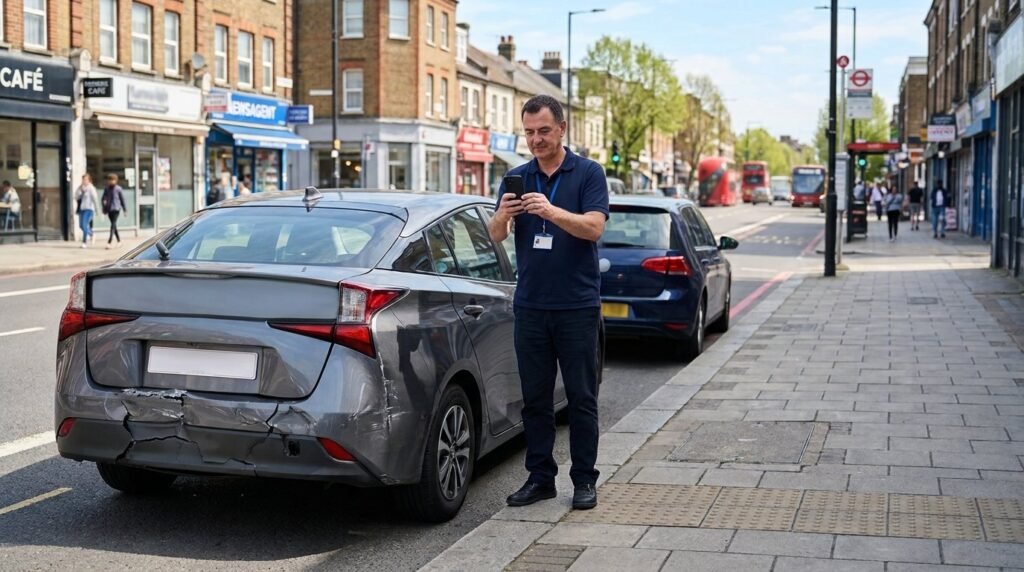
If another driver caused the crash, your claim goes to their insurer, not to Uber and not on your own policy. That covers the repair or the value of your car, a plated replacement so you can keep working, your lost earnings and any injuries, including your passenger’s. Uber doesn’t pay for your car in the UK. Your car is covered by your own private hire insurance, and Uber’s Partner Protection is personal accident cover for injuries. National Accident Support Line arranges a plated replacement for PCO drivers and pursues the rest from the at-fault insurer.
It usually happens mid-trip. The app is still running, there’s a passenger in the back asking if they can go, and the other driver is already saying it was nobody’s fault. In the next ten minutes you need to look after your passenger, get the right details and avoid saying yes to anything you’ll regret, all while working out how you’re going to earn this week.
No excess to pay if the accident wasn’t your fault. Fill in our form and we’ll call you back within 2 minutes.
What to do at the scene when you have a passenger
Check everyone is all right first, your passenger included. If anyone is hurt, call 999. Then, when it’s safe:
- Get the other driver’s name, address, phone number, registration and insurer. If they won’t give them, you must report the accident to the police as soon as you reasonably can, and within 24 hours at the latest.
- Take photos of both vehicles, the number plates, the road layout and anything that shows how it happened. Save your dashcam footage before it records over.
- Ask your passenger for their name and a phone number. They’re a witness, and if they’re hurt they may have a claim of their own.
- Note any other witnesses, and anything the other driver says about how it happened.
- Don’t agree to settle in cash at the roadside. Damage that looks like a scuff can hide a cracked bumper bracket or a parking sensor, and once you’ve taken the cash, the rest is hard to get back.
You can end the trip or let the passenger get another car once they’re safe and you have their details. Report the crash to Uber through the Driver app as soon as you reasonably can.
Who you need to tell, and by when
Drivers often tell Uber and assume that’s everything. It isn’t. These are the people who need to hear about it:
| Who | Why | When |
|---|---|---|
| Uber, through the Driver app | Uber asks drivers to report every crash, and it’s how a claim under its Partner Protection cover starts | As soon as you reasonably can |
| Your own private hire insurer | Almost every policy says you must report any accident, even one that wasn’t your fault. Telling them isn’t the same as claiming | Within the time your policy sets, often straight away |
| Your licensing authority (TfL in London) | In London the owner of a licensed private hire vehicle must report an accident that affects the car’s safety, performance or appearance within 72 hours. Most councils have a similar rule | Within 72 hours in London; check your council’s conditions elsewhere |
| The police | Only if someone was injured and you couldn’t exchange insurance details, or the other driver didn’t give their details at all | As soon as you reasonably can, and within 24 hours |
One trap to avoid: some of Uber’s help pages that turn up in Google are written for the United States. They mention state insurers, a $2,500 deductible and say there’s no need to tell your personal insurer. None of that applies to a UK private hire driver.
What Uber’s insurance does and doesn’t cover
Uber’s UK Partner Protection cover is provided by Allianz Partners. There’s no need to sign up and it doesn’t cost you anything. Eligible drivers are covered automatically from the moment they accept a trip until 15 minutes after it ends, with some extra cover for life events when you’re off-trip.
What it’s for is you, not your car. On-trip, it can pay towards medical costs not covered by the NHS, a lump sum if you’re in hospital for more than 24 hours, and daily payments for up to 30 days if an accident injury stops you working. Uber says plainly that it isn’t commercial motor insurance and doesn’t replace yours.
So it doesn’t repair your car, give you a replacement or pay for the days your car is off the road. Those come from the at-fault driver’s insurer. You can claim under Partner Protection and claim against the other driver at the same time, because they cover different things.
No excess to pay if the accident wasn’t your fault. Fill in our form and we’ll call you back within 2 minutes.
Keeping your earnings going while the car is off the road
The car is your income, so the replacement matters more than anything else. A courtesy car from a garage or insurer isn’t plated, so you can’t take a single trip in it. If that’s all you’re offered, you’re still off the road as far as the app is concerned.
After a non-fault accident you’re entitled to a replacement equivalent to your own car, and for a working driver that means a plated one, licensed for private hire in your area and suitable for the app. On credit hire, the hire charges are recovered from the at-fault insurer rather than paid by you.
For any days you couldn’t work before the replacement arrived, you can claim the money you lost. Our guide to loss of earnings claims for taxi and PCO drivers shows how that’s worked out and the statements you’ll need from the app.
What about your passenger?
If your passenger was hurt, they can claim for their injuries. When the other driver caused the crash, that claim goes to the other driver’s insurer, not to you or your policy. Make sure they have the other driver’s details, or at least your insurer’s details and the date and place, so their claim can be routed correctly.
Keep a note of what your passenger told you at the scene about any pain or injury. If the other side later questions how the crash happened, that note and their contact details can help both claims.
Will it affect your insurance?
A non-fault accident shouldn’t count against your no-claims discount once the other insurer accepts liability. But private hire insurers can still look at any accident at renewal, and a claim left open on your record is the thing most likely to push your price up. Drivers on the Uber Drivers Forum describe paying higher premiums for two years because a non-fault claim was never closed.
The fix is to get liability settled. Send your photos, footage and witness details early, and if the other driver changes their story, our page on how fault is decided after a road traffic accident explains what insurers look at.
How NASL handles an Uber driver’s claim
Tell us what happened by the form, WhatsApp or a call to 0333 212 2730. We check the accident wasn’t your fault and confirm a plated car is available for your licensing area before anything else moves. We aim to have the plated replacement with you within 48 hours, with a standard car in the meantime if you need to stay mobile.
The claim goes to the other driver’s insurer, so there’s no excess to pay and your own policy isn’t used. Our in-house recovery team pursues the hire charges, the repair or write-off value and your lost earnings, and argues the case if the other side disputes fault. If the evidence says the accident was your fault, we’ll tell you straight away.
What drivers tell us
“My insurer passed me to a company, who passed me to another company”
It happens a lot. Many insurers refer non-fault claims to partner firms, and a driver can end up with three phone numbers and nobody owning the claim. You can choose who handles a non-fault claim. Ask whoever has it who is arranging your replacement, who is recovering the costs, and what you’d owe if fault is later disputed. Our page on an accident management company versus your insurer sets out the differences.
“The other driver offered cash to keep it off the insurance”
It’s tempting when the damage looks small and you want to get back online. But you can’t see under the bumper, and a repair that turns out to cost three times the cash leaves you with nothing to claim against. Take their details whatever you decide, and still report the accident to your own insurer.
“My car still drives, but there’s a dent. Can I keep working?”
Maybe not. In London, damage that affects the car’s appearance has to be reported to TfL within 72 hours, and a licensed car is expected to be kept in good condition. If the dent is more than cosmetic, report it and get the car assessed before you take passengers again.
“The car that hit me was another Uber”
That makes no difference to the claim. The other driver’s own private hire insurer deals with it, the same as any other at-fault driver. If they had no insurance, see our page on being hit by an uninsured driver.
Frequently asked questions
Does Uber pay for my car if someone hits me?
No. In the UK your car is covered by your own private hire insurance, and if someone else caused the crash, their insurer pays for your repair, a replacement and your other losses. Uber’s Partner Protection covers injuries, not vehicles.
Do I have to report an accident to Uber?
Uber asks drivers to report every crash through the Driver app. It’s also how you start a claim under Partner Protection if you were injured on a trip.
Do I have to tell TfL about an accident?
In London, yes, if the accident affects the car’s safety, performance or appearance, within 72 hours. Other licensing authorities have their own rules, often with a similar deadline.
Can I drive for Uber in a replacement car?
Yes, if it’s a plated private hire vehicle licensed in your area and meets the app’s vehicle requirements. A standard courtesy car can’t be used for trips.
Can I claim for lost earnings as an Uber driver?
Yes. If another driver caused the accident, you can claim your net lost earnings for the days you couldn’t work, using your app statements and tax returns as evidence.
Does it matter if I was between trips when it happened?
Not for your claim against the other driver, which works the same whether you were on a trip, waiting for one or off the app. It can matter for Uber’s Partner Protection, which has different cover on-trip and off-trip.
I deliver for Uber Eats. Is it the same?
Mostly, but the replacement needs to suit delivery work rather than passengers. See our page on accident claims for couriers and delivery drivers.
No excess to pay if the accident wasn’t your fault. Fill in our form and we’ll call you back within 2 minutes.