

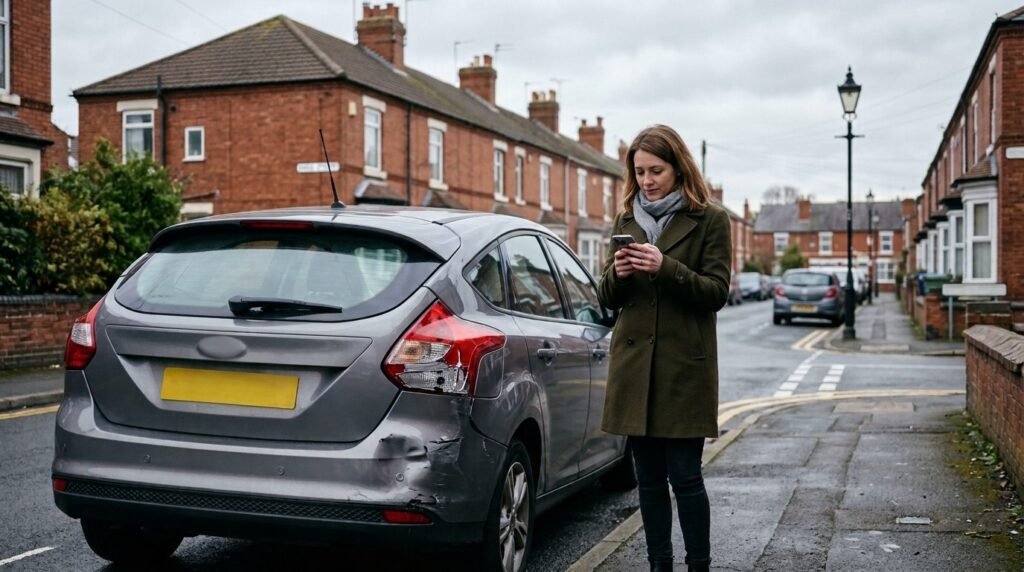
If you’ve been hit by an uninsured driver, or had an accident with an uninsured driver, and it wasn’t your fault, you can still be compensated: your own comprehensive policy pays for the repairs, and the Motor Insurers’ Bureau (MIB) covers your injury and the losses your policy doesn’t, or the damage to the car itself if you only have third party cover. It runs differently from a standard claim against a driver who was insured, it’s usually slower, and a few rules catch people out early on. National Accident Support Line can tell you on a short call which route your claim takes.
It tends to come out in one of a few ways. The other driver has no documents and gives a mobile number that stops answering. They ask you not to report it and offer cash. The askMID check comes back blank. Or the car turns out to be insured, just not for the person driving it. Each leads somewhere different, and this guide sets out the routes for England and Wales.
Hit by a driver with no insurance? Fill in our form and we’ll call you back within 2 minutes.
First, check whether they really are uninsured
The Motor Insurance Database, run by the MIB, holds the insurance records for vehicles insured in the UK, and you can check it through askMID. At the roadside there’s a free askMID check you can run on your phone, which confirms whether the other vehicle shows as insured and sends you the insurer’s details. Afterwards, the one-off askMID search for people involved in an accident asks for the accident date, the other vehicle’s registration and your own vehicle’s details, and gives the insurer’s name and policy number if there is one.
A blank result isn’t proof there’s no insurance. A policy taken out in the last few days may not show yet, and some vehicles don’t appear for other valid reasons, so pass the registration to your insurer and let them check properly.
There’s also a middle case people miss. If the car had a policy but the person driving wasn’t covered by it, the car’s insurer may still have to deal with your claim under the Road Traffic Act 1988, sometimes on the MIB’s behalf. Then the claim can run much like a normal one, so find out exactly whose car it was.
What to do at the scene when the other driver has no insurance
Make it safe. Hazard lights on, everyone out of the traffic. Call 999 if anyone is hurt, the road is blocked, or the other driver seems drunk or aggressive.
Get the details the law requires. Under section 170 of the Road Traffic Act 1988, a driver involved in an accident that damages another vehicle must give their name and address, the owner’s name and address and the registration to anyone who reasonably asks. If someone is injured, they must also produce their insurance certificate. Photograph the car and its number plate whatever happens, and their licence if they’ll show it.
Run the askMID check while you’re still there.
Gather the evidence. Photos of both vehicles and the wider scene, dashcam footage saved the same day, and witnesses’ names and numbers. The MIB looks at fault just as an insurer would.
Don’t take cash or agree to keep it quiet. It’s the offer uninsured drivers make most, and it often falls through once the repair estimate arrives.
Report it to the police. If the other driver wouldn’t give their details, or someone was hurt and no insurance certificate was produced, the accident must be reported as soon as reasonably practicable and in any case within 24 hours. The MIB also asks for accidents to be reported, and the police can seize a vehicle being driven uninsured, so call 101, or 999 if it’s urgent.
Tell your own insurer, even if you don’t plan to claim on your policy.
Who pays for what after an accident with an uninsured driver
It depends mostly on your own cover, because for accidents since 1 August 2015 the MIB won’t pay for damage to your car if you have comprehensive insurance on it.
| Your cover | Repairs to your car | Your excess and no-claims discount | Injury and other losses |
|---|---|---|---|
| Comprehensive, with an uninsured driver promise | Your own insurer | No excess (or it’s refunded) and your discount kept, once the other driver is confirmed uninsured and at fault | The MIB |
| Comprehensive, no promise | Your own insurer | You may pay the excess and your discount may be affected; the excess can usually be claimed from the MIB as a loss | The MIB |
| Third party only, or third party fire and theft | The MIB, with no excess taken off | Not affected, as your own policy isn’t claimed on | The MIB |
| Car insured, driver not covered | The car’s insurer may have to deal with it | As on a normal claim against an insurer | The car’s insurer, or the MIB |
The MIB and the Uninsured Drivers Agreement
The MIB is funded by the UK’s motor insurers and compensates victims of uninsured and untraced drivers under agreements with the Secretary of State for Transport. For accidents in England, Wales and Scotland on or after 1 August 2015, claims against an identified uninsured driver fall under the Uninsured Drivers Agreement 2015, as changed by a 2017 Supplementary Agreement. Earlier accidents come under the 1999 agreement. These are the terms that matter most.
| The rule | What it means for you |
|---|---|
| Comprehensive cover comes first | The repair or write-off goes through your own policy. The MIB won’t pay it, or pay your insurer back |
| Property damage limit | Up to £1 million in total for property damage from one accident, shared between everyone claiming |
| No excess | Nothing is deducted from property damage caused by an identified uninsured driver. The £300 excess still quoted online comes from older rules; today’s £400 excess applies to hit and run claims |
| Other sources first | No payment for anything you’ve received, or could claim, from someone else, including your own insurer, or for a claim you could have made on a policy but didn’t, or made too late |
| Fault still counts | The uninsured driver has to be shown to be at fault, and any share of blame on you reduces the payment |
| Passengers | A passenger who knew or had reason to believe the vehicle was stolen or uninsured can’t claim |
| Time limits | In England and Wales, three years for injury (for a child, from their 18th birthday) and six years for damage to the car. Scotland allows five years for property damage |
The 2015 agreement sets no fixed number of days for reporting, but that isn’t time to spare. The MIB says delay can invalidate a claim, you must tell it promptly once you know the driver had no insurance, and if the claim goes to court the MIB has to be a party from the start. That’s one reason injury claims against uninsured drivers are best run by a solicitor who handles them regularly.
What the MIB pays, and the hire car question
The MIB can pay for your injury and its effect on your life, lost earnings, treatment, travel and care, damage to your car if you don’t have comprehensive cover, your belongings, recovery and storage, and other losses your own insurance doesn’t cover.
Hire charges are where people go wrong in both directions. The MIB can pay for a replacement vehicle, including credit hire charges, where they were reasonably incurred: you needed a car, and the rate and the length of the hire were reasonable. Two limits apply. It doesn’t pay for anything your own insurance provides, so if your policy gives you a courtesy car or hire cover, expect to be asked why you didn’t use it. And where a credit hire agreement comes with its own insurance against unpaid charges, the MIB’s guidance says it is only liable if you didn’t have that protection, so that policy is expected to pay.
So a hire car on an uninsured driver claim is possible, but less certain than on a claim against an insured driver. Before you sign for one, ask what you would owe if the MIB refused or cut the charges, and read the questions to put to a hire company before you sign.
Claiming on your own policy and the uninsured driver promise
If you have comprehensive cover, you can’t skip your policy and send the repair bill to the MIB. If you have the car repaired without telling your insurer, and it then refuses to pay because it was told late or didn’t get to use its own repairer, the MIB won’t pay those repairs either.
Many comprehensive policies include an uninsured driver promise: if an uninsured driver hits you and it wasn’t your fault, you don’t pay the excess (or it’s refunded) and your no-claims discount isn’t affected. The usual conditions are comprehensive cover, no fault on your part, and the other vehicle’s registration, often with the make and model and sometimes the driver’s name and address. Some insurers take the excess first and refund it once the other driver is confirmed as uninsured and to blame.
The promise matters because your insurer can’t recover its outlay from the MIB. Without it, some insurers record the claim against your no-claims discount, so check your policy booklet before you call. It will also say whether you get a courtesy car, usually a small one for the time the repair takes at the insurer’s garage, and often nothing if the car is written off.
Hit by a driver with no insurance? Fill in our form and we’ll call you back within 2 minutes.
If the driver drove off before you got their details
If the driver can’t be traced, the claim comes under a different agreement, the Untraced Drivers Agreement 2017. It’s stricter on vehicle damage: the MIB only pays where someone also suffered a significant injury in the same accident (death, two or more nights in hospital, or three or more hospital outpatient sessions), and it takes off a £400 excess. The MIB’s guidance asks for hit and run claims to be reported to the police within 14 days. Our guide to claims against drivers who leave the scene and can’t be found covers that route.
Situations people describe to us
“They offered me cash and asked me not to report it”
Take the details anyway, photograph the car and the plate, and don’t sign anything. Private deals often collapse once a garage finds the damage behind the bumper, by which time the number may not answer. You still have to tell your insurer, and the MIB route stays open if the money never arrives.
“askMID shows nothing, but they swear they’re insured”
They may be right. Give the registration to your insurer and to us, and let the insurer be found properly. If there is a policy, your claim goes against it in the usual way.
“The police dropped the case against the other driver”
Whether the driver is prosecuted doesn’t decide your claim. The MIB looks at the evidence of how the accident happened, not the outcome of the criminal case, though a police report helps.
Where National Accident Support Line fits in
First we find out whether there’s an insurer behind the other vehicle after all: a policy that didn’t show on the first check, or a car that was insured even though its driver wasn’t. If there is, the claim can usually run like any other non-fault claim, and our page on the replacement vehicles we arrange when the other side is insured explains the hire car side. If the driver really had no insurance, we’ll explain how your cover affects the repair, and if you were hurt we refer the injury claim to a specialist solicitor who handles MIB claims. For a replacement car on an uninsured driver claim, we’ll tell you on the call what we can arrange. If there’s nothing we can do, we’ll say so.
Frequently asked questions
What happens if someone without insurance hits your car?
You can still be compensated. With comprehensive cover, your own insurer repairs the car and the MIB deals with your injury and other losses. With third party cover only, the MIB pays for the damage to your car as well.
Can I claim from the MIB if I have comprehensive insurance?
Yes, but not for the repair. For accidents since 1 August 2015, the MIB won’t pay vehicle damage a comprehensive policy covers. It can still pay for injury and the losses your policy doesn’t cover.
Is there an excess on an MIB claim?
Not on property damage caused by an identified uninsured driver. A £400 excess applies to vehicle damage after a hit and run where the driver is never traced.
Will the MIB pay for a hire car?
It can pay reasonable hire charges, including credit hire, if you needed a car. It won’t pay where your own insurance covers it, and it expects any insurance that comes with a hire agreement to be used first.
How long do I have to claim against an uninsured driver?
In England and Wales, three years for injury and six years for damage to your car, from the date of the accident. Tell the MIB as soon as you know the driver had no insurance, because delay can harm the claim.
Will being hit by an uninsured driver affect my no-claims discount?
Not if your policy has an uninsured driver promise and you meet its conditions. Without one, it depends on your insurer, because it can’t recover its costs from the MIB.
Can I sue the uninsured driver myself?
You can, but many uninsured drivers have no money to pay a judgment, which is why the MIB exists. If a claim does go to court, the MIB has to be made a party from the start.
Hit by a driver with no insurance? Fill in our form and we’ll call you back within 2 minutes.