

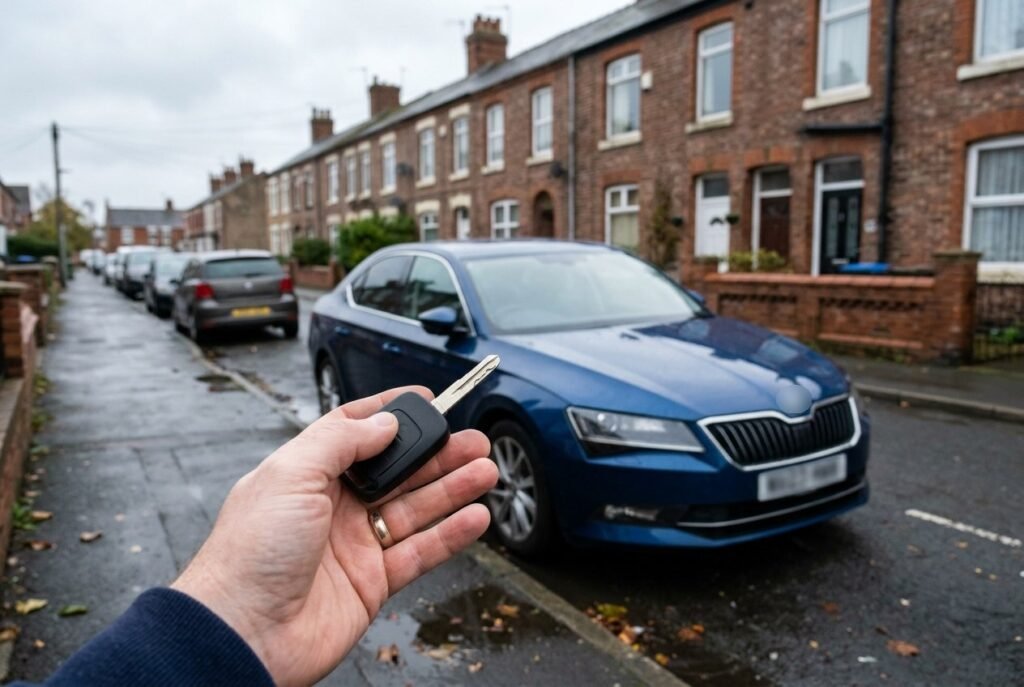
If the other driver is denying liability, you can usually still have a hire car: on a credit hire claim the replacement stays with you while fault is argued, provided the evidence backs your account, and the hire charges are claimed from the at-fault driver’s insurer once liability is settled. National Accident Support Line checks the evidence before arranging a replacement car that matches yours, and if their insurer disputes it, our in-house recovery team argues the case and you stay in the vehicle while it does.
It usually starts the same way. The other driver apologises at the roadside, you swap details, and a week later a letter from their insurer says its policyholder “does not accept responsibility”. Sometimes they now say you were speeding, or that you pulled out, or that you braked for no reason. Meanwhile your car is in a garage and you still have to get to work. This guide covers the evidence that changes a dispute, your hire car and repairs while it runs, shared blame and timescales.
No excess to pay if the accident wasn’t your fault. Fill in our form and we’ll call you back within 2 minutes.
What a liability dispute is, and why insurers dispute
Liability is legal responsibility for the accident. An insurer disputing it is saying it won’t pay your claim in full, because it says its driver wasn’t to blame or that you share the blame. As the person claiming, you have to show that the other driver was negligent, and the test is the balance of probabilities: was your version more likely than theirs?
Insurers dispute for several reasons, and not all of them mean the other driver is lying:
- Their driver has given a different account, and there is nothing independent to choose between the two.
- The damage to the cars doesn’t obviously match either story, so they want an engineer to look at it.
- Their driver hasn’t replied to them yet, and they won’t admit anything until they have a statement.
- They suspect the accident was staged or exaggerated. Insurers are wary of this, particularly with low-speed collisions at junctions and roundabouts.
- They are challenging the hire and repair costs as much as the accident itself.
A denial in the first letter is often an opening position. For the usual starting points in common collisions, such as junctions, lane changes and car parks, see who tends to be blamed in each type of crash.
The evidence that moves a disputed claim
When it’s one account against another, independent evidence decides it. Most of it has a short shelf life, so the first few days matter more than anything that happens later.
| Evidence | Why it carries weight | What to do, and how soon |
|---|---|---|
| Dashcam footage | Shows positions, speed and signals, with a time stamp | Save the clip the same day, before the camera records over it. Keep the original file, not just a phone recording of the screen |
| CCTV | Independent and hard to argue with | Ask shops, petrol stations, bus companies and the council quickly. Much of it is wiped within days or weeks. Footage in which you can be identified can be requested under data protection law |
| Independent witnesses | No stake in the outcome | Get names and numbers at the scene, and ask them to write down what they saw while it’s fresh. A passenger in either car counts for less |
| Photos | Show where the cars ended up and where each one was hit | Photograph both cars before they’re moved, the road markings, signs and any debris. The point of impact often tells the story |
| Police reports | Record what the officers found at the scene | Note the reference number. Forces usually charge for a collision report, and may not release it until any prosecution is over. If the other driver is convicted of a driving offence over the crash, that conviction can be relied on in the civil claim |
Write your own account with a sketch of the road while it’s fresh, and send everything to whoever is handling your claim rather than to the other side.
How credit hire works while fault is argued
A car offered by the other driver’s insurer is often taken back once it decides to dispute liability. Credit hire works differently: the hire company supplies the vehicle on credit and the charges are claimed from the at-fault insurer at the end, so the car doesn’t depend on that insurer agreeing to pay first.
That is why the check at the start matters. Before a vehicle goes out, we look at what happened and what evidence you have. If it supports you, we arrange the replacement and the repair, and when the other side disputes liability, our recovery team takes it up with their insurer on the evidence while you carry on driving. If the evidence is thin, or points towards a split, we’ll tell you on the first call, because a hire on a claim that’s likely to fail helps nobody. The Financial Ombudsman Service takes the same view: referring someone to credit hire may be unsuitable where it should have been clear the other side would dispute liability.
You sign a credit hire agreement. What you could owe if the claim doesn’t succeed depends on the agreement, so ask that question before you sign, and we’ll go through it with you on the call. For the wider picture, including witness statements and court, read what happens when a hire claim is fought in court.
When the other driver’s insurer changes its story
Two different things get called “admitting fault”. A driver saying sorry at the roadside isn’t a binding admission, and their insurer can still deny it. An insurer that has admitted liability in writing and then goes back on it is less common, but it happens, usually because its driver has given a different account or it has new evidence.
Don’t argue it with them yourself; pass the letter to whoever is handling your claim. If the case reaches court, the court decides whether the insurer can withdraw its admission, looking at why it changed position, whether there is genuinely new evidence and how far the claim has got. A change of story with no new evidence behind it doesn’t change what your evidence shows, and that is what the claim turns on.
No excess to pay if the accident wasn’t your fault. Fill in our form and we’ll call you back within 2 minutes.
Split liability: what it means for your hire and repair costs
Sometimes the honest answer is that both drivers contributed, or that nobody can prove what happened. Liability is then split, for example 50/50 or 70/30. Under the Law Reform (Contributory Negligence) Act 1945, a driver who was partly responsible can still claim, but the amount is cut in proportion to their share of the blame. The split works both ways: the other driver also claims their share of their losses from your insurer.
| How liability ends up | Your repair | Your hire charges | The other driver’s losses |
|---|---|---|---|
| Fully their fault | Claimed in full from their insurer | Claimed in full from their insurer, if the hire was needed and reasonable | Nothing from you |
| 70/30 in your favour | 70% from their insurer. The rest through your own policy if you’re comprehensive, usually less your excess | 70% recoverable from their insurer. Who covers the rest depends on your hire agreement | Your insurer pays 30% of theirs |
| 50/50 | Half from their insurer, the rest as above | Half recoverable. The rest depends on your hire agreement | Your insurer pays half of theirs |
| Mostly or fully your fault | Your own policy, if your cover includes your car | Not recoverable from them | Your insurer pays most or all of theirs |
A split usually goes on your record as a fault claim. With third party cover only, your own policy won’t pay for your repair, so any shortfall is yours. If your evidence is good, have it looked at properly before you agree to share the blame.
How long liability disputes take
There’s no fixed timetable, but these are the usual stages:
- First response from their insurer: often within a few weeks. Where an injury is claimed, the personal injury pre-action protocol gives the insurer up to three months from acknowledging the claim to say whether it accepts liability.
- Exchanging evidence and negotiating: weeks to several months, depending on how quickly footage, statements and engineers’ reports come in.
- Court proceedings, if it doesn’t settle: the government’s figures for April to June 2026 put the median wait from issue to trial at about 41 weeks for small claims and about 56 weeks for larger ones.
Most disputes settle before a trial, often once the evidence has been exchanged, and sometimes only weeks before the hearing date. In England and Wales the deadline for issuing a claim for vehicle damage is normally six years from the accident, and three years for an injury; in Scotland it is usually five years for damage. Disputes rarely run that long, but the deadlines are there.
When a disputed claim goes to court
If the insurers can’t agree, the claim can be issued in the county court. Smaller claims go on the small claims track, where each side usually pays its own legal costs, and larger ones on the fast track or above. A judge hears both drivers and decides on the evidence who was to blame, or in what proportions. You might be asked for a witness statement about the accident and why you needed the hire car, and to attend the hearing, but very few disputes get that far.
Situations people describe to us
“Their insurer gave me a car, then took it back when their driver changed his story”
This is common. A car supplied by the other driver’s insurer is theirs to withdraw. Send us what you have: photos, footage, witness details and their letter. If the evidence supports you, we’ll tell you on the call whether we can take the claim on and arrange a replacement.
“It’s been three months and they still haven’t decided”
Delays often mean their own driver hasn’t co-operated. That doesn’t stop your claim. Under the Road Traffic Act 1988, an insurer still has to meet a valid claim against the driver it covers, even if that driver has broken the policy terms. Keep your evidence together and keep asking for a decision in writing.
“I was hit from behind and they say I braked suddenly”
That argument rarely gets far, because the driver behind should leave room to stop. There’s more on the sudden-braking defence in rear-end claims.
Frequently asked questions
Can I still get a hire car if the other driver denies liability?
Often, yes. If the evidence supports your account, a replacement can be arranged on credit hire while the dispute is argued. If it doesn’t, we’ll say so and point you to your own insurer.
Will I have to give the hire car back while the dispute goes on?
On our claims, our recovery team argues the dispute with the other insurer and you stay in the vehicle while it does. The hire runs while your own car is off the road because of the accident.
What happens to the hire charges if liability is split?
Only the other side’s share is recoverable from their insurer. With a 70/30 split in your favour, that’s 70%. What happens to the rest depends on your hire agreement, so ask before you sign.
Could I end up paying for the hire car if the claim fails?
That depends on the agreement you sign. Read it, and ask what you would owe if liability were disputed and the claim failed. We go through this with you on the call before anything is signed.
How long does a liability dispute usually take?
Some settle within weeks, once footage or a witness statement turns up. Others take months, and a few go to court, which can take around a year from the claim being issued.
Can the other insurer withdraw an admission of liability?
It can try. A roadside apology doesn’t bind anyone. If a written admission is withdrawn and the case reaches court, the court decides whether to allow it, looking at the reasons and any new evidence.
Should I claim on my own insurance instead?
It can make sense where the evidence is weak or a split looks likely, because your insurer then argues it for you under your policy. Our guide to going through your own policy after a non-fault crash sets out the trade-offs.
No excess to pay if the accident wasn’t your fault. Fill in our form and we’ll call you back within 2 minutes.