

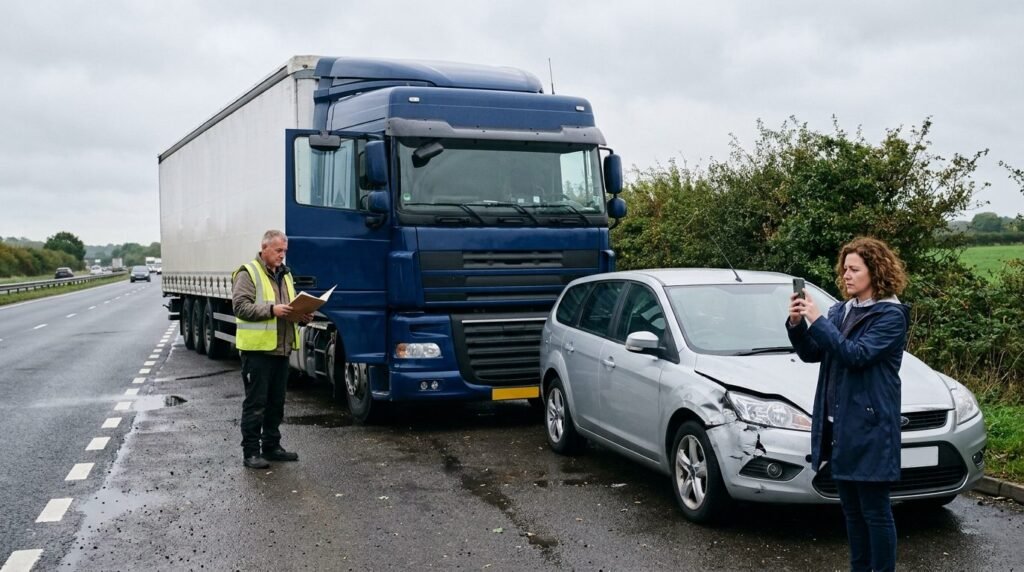
If a foreign-registered vehicle hits you in England, Wales or Scotland and it wasn’t your fault, you still claim here, under UK law and in English: the claim goes to the foreign insurer’s UK representative, or to the Motor Insurers’ Bureau (MIB) if there isn’t one or the insurer can’t be identified. The repair, a hire car, recovery and your other losses are claimed in the same way as any claim for your car after a crash someone else caused. National Accident Support Line handles the vehicle side of non-fault claims, and on the call we’ll tell you how a claim against a foreign vehicle would run in your case.
The usual version is a motorway sideswipe. A left-hand-drive lorry moves into your lane, there’s a scrape down the side of the car, and on the hard shoulder the driver speaks little English and hands you a document you can’t read. Or it’s a continental car at a roundabout near a port, and plates you don’t recognise. These claims get paid like any other, but they’re slower, mostly because of details nobody took at the roadside.
No excess to pay if the accident wasn’t your fault. Fill in our form and we’ll call you back within 2 minutes.
Who pays when a foreign vehicle hits you in the UK
Every vehicle on UK roads has to be insured, visitors included. Foreign vehicles are covered through the Green Card system, an arrangement between 47 countries in Europe, Asia and North Africa. Each country has a national bureau that makes sure people hit by visiting drivers are compensated. The UK’s is the MIB, which also deals with uninsured and untraced drivers.
Most foreign insurers have a UK representative, usually a UK insurer or claims firm acting as their agent, which deals with your claim as if it were a UK one. The MIB’s website has a tool to find it: choose the country the vehicle is registered in, then enter the insurer’s name or the green card number. If the insurer can’t be identified or has no representative, you claim to the MIB, which traces the insurer through the bureau in the vehicle’s home country or deals with the claim itself. The representative stays answerable to the MIB.
Fault and what you can recover are decided under the law of the part of the UK where it happened, and the time limits are the usual ones: three years for an injury and six years for damage to the car in England and Wales, with five years for vehicle damage in Scotland.
| What hit you | Who deals with the claim | What you need to start |
|---|---|---|
| A foreign car, van or lorry, insurer known | The insurer’s UK representative | Registration, country, insurer’s name and the green card number if there is one |
| A foreign vehicle, insurer not known | The MIB, which traces the insurer abroad | Registration and country, photos, the driver’s name and address |
| A foreign vehicle with no valid insurance | The MIB | The above, plus the police reference |
| A foreign driver in a UK-registered car, such as a hire car | The UK insurer of that car, as a normal claim | The registration; the MIB’s askMID service can find the insurer |
| A foreign vehicle that drove off | The MIB, as a hit and run | A police report within 24 hours and any part of the plate |
What changed after Brexit
For crashes in the UK, less than people think. The Green Card system isn’t an EU scheme, so a claim against a French, Polish or Spanish vehicle that hits you here still runs through the insurer’s UK representative or the MIB, in English.
The paperwork changed. Since 2 August 2021 the UK has been part of the Green Card free circulation area, so drivers from the EU and EEA, and from Andorra, Bosnia and Herzegovina, Montenegro, Serbia and Switzerland, don’t have to carry a green card here, and UK drivers don’t need one there. For those vehicles the registration plate is the key detail. Vehicles from countries outside that area, such as Turkey, Ukraine or Albania, should still carry one.
The bigger change is for UK drivers who crash in the EU, covered further down.
What to collect at the scene when the other vehicle is foreign
The usual steps still apply: make it safe, take photos and witness details, save any dashcam footage. Then add these.
The registration and the country. Photograph the plate. On EU plates the country letters sit in the blue band on the left: PL, D, F, RO and so on. Write the country down too.
Both plates on a lorry. In many countries the trailer is registered separately, so the plate on the back of the trailer isn’t the lorry’s registration. Get the front plate of the cab as well, plus the haulier’s name and any phone or fleet number on the cab or trailer.
The insurance document. Photograph both sides of the green card or insurance certificate if there is one. Despite the name, a green card is often printed on plain white paper now. What matters is the card number, the registration it covers and the insurer’s name and address. If there’s no card, ask for the insurer’s name; many drivers have it on their phone.
The driver. Name, home address, phone number, and where they’re staying or delivering in the UK. For a lorry driver, the company they drive for matters more than their own address.
The European Accident Statement. Visiting drivers often carry this two-part form and may ask you to fill it in. It isn’t standard here, but the layout is the same in every language, so the numbered boxes line up even if your copy is in English and theirs isn’t. Fill in only your side, check the sketch and the tick boxes, and sign only what you understand and agree with. Write any disagreement in your observations box before signing, because once both drivers have signed, the front shouldn’t be changed. Photograph the finished form and keep your copy.
The police. If the driver won’t give details, or someone is hurt and they can’t produce insurance, report it to the police as soon as you reasonably can and within 24 hours. Call 999 if anyone is injured or the road is blocked. If they drive off, there’s a separate route for a driver who leaves without giving details.
How the claim runs, and why it often takes longer
You must still tell your own insurer the accident happened, but you don’t have to claim on your own policy. The claim can go straight to the foreign insurer’s representative, which keeps your excess out of it. If you claim on your own comprehensive cover instead, your insurer will usually hold the excess until it recovers its costs from the foreign side, and drivers in this position often say that took the best part of a year.
The delays have ordinary causes: finding the insurer, and taking the driver’s account in another country and language. Keep everything in writing, and if a UK agent stops replying, raise it with its claims manager, then the MIB.
Fault is decided as in any UK crash, on the evidence and the Highway Code; see how blame is weighed up between the two insurers. Sideswipes by left-hand-drive lorries are common because the driver sits on the far side from a car alongside them on the right. That doesn’t excuse the move: rule 133 says a driver changing lane should check their mirrors, glance sideways if needed, and make sure they won’t force anyone to change course or speed. If the car is written off, first offers on older cars are often low, so read what a fair write-off settlement includes before you accept.
A hire car while yours is off the road
The foreign plates don’t change what you’re entitled to. If the accident wasn’t your fault and you need a car while yours is repaired or the write-off is settled, the reasonable cost of a car like yours is part of the claim.
On our claims a replacement is arranged as a like-for-like car on credit while yours is fixed, the same size and class as your own, with the hire charges claimed from the at-fault side at the end of the claim rather than paid by you up front. Whether we can arrange one on a claim against a foreign vehicle depends on liability being clear and on who is handling the claim for the insurer, and we’ll confirm that on the call before a car is delivered. You sign a credit hire agreement, so read it and ask what you’d owe if fault were disputed later, whether there’s an excess on the hire car, and who pays for fuel, fines and late return. Our guide to the agreement you sign for a car on credit hire explains each point.
If the foreign vehicle turns out to be uninsured, the MIB’s own rules decide what it pays, and a hire car may be harder to recover. Tell us on the call and we’ll say what can be done.
No excess to pay if the accident wasn’t your fault. Fill in our form and we’ll call you back within 2 minutes.
If you were hurt, in brief
An injury caused by a foreign driver in the UK is claimed here, under UK rules, against the same insurer or the MIB, and the whiplash rules for adult drivers and passengers in England and Wales apply as usual. We can refer the injury to a specialist solicitor: see how we pass on injury claims from a road crash.
An accident while driving in the EU
This is where Brexit made the difference. For accidents in the EU from 1 January 2021, the MIB no longer acts as the compensation body for UK residents, and in most cases you can’t bring the claim at home in English. It is usually made in the country where the crash happened, under its law, against the other driver’s insurer, which you can claim against directly anywhere in the EU.
At the scene, call 112 if anyone is hurt. Whether police attend a crash with no injuries varies by country; if they come, get the report number. Use the European Accident Statement (the constat amiable in France) as above: your side only, a careful sketch, and any disagreement written in before you sign.
Afterwards, tell your own insurer straight away, as some policies set short deadlines for accidents abroad, and check whether you have legal expenses cover, which often pays for a lawyer in that country. Your insurer may have a claims representative there, and if you can’t find out who insures the other driver, the MIB’s UK Information Centre may be able to help. Don’t assume UK time limits apply: some countries’ are much shorter, in some cases a year.
Our service is for accidents in England, Wales and Scotland. If yours happened abroad, ring us anyway, and we’ll tell you whether we can help or who to speak to.
What drivers tell us after a crash with a foreign vehicle
“A foreign lorry clipped me changing lanes and kept going”
Report it to the police within 24 hours with whatever you have: part of the plate, the country, the haulier’s name, the time and the junction. A trailer plate on its own can sometimes lead to the operator, and the MIB can work through the bureau in that country. Save the dashcam footage today, before it records over.
“My insurer says it’ll take a year because the other car is foreign”
That’s often about recovering your excess, not fixing your car. You don’t have to wait on your own policy: the claim can go to the foreign insurer’s representative. Tell us what happened and we’ll say how it can be handled.
Frequently asked questions
Can I claim if a foreign driver hit me in the UK?
Yes. If it wasn’t your fault, you claim here under UK law against the foreign insurer’s UK representative, or through the MIB if there isn’t one or the insurer can’t be found.
Do EU drivers need a green card to drive in the UK?
No. Since 2 August 2021 drivers from the EU, the EEA and a few nearby countries don’t need one here. Drivers from countries such as Turkey or Ukraine should carry one.
What if the foreign vehicle had no insurance?
The claim goes to the MIB. Report it to the police and keep the reference, because it will be needed.
Can I get a hire car if a foreign vehicle hit me?
A like-for-like car is part of what a non-fault driver can claim, whatever the other vehicle’s plates. Whether we can arrange one on credit hire for your claim depends on liability and who is handling it, and we’ll confirm that on the call.
How long do I have to claim against a foreign driver?
The same as any UK crash: three years for an injury (from 18 for a child), and six years for vehicle damage in England and Wales or five in Scotland. Start early, because these claims take longer to set up.
What happens if I crash in Europe and it wasn’t my fault?
Report it as that country requires, fill in a European Accident Statement carefully and tell your insurer straight away. Since 2021 the claim is usually made in that country, under its law, so check your policy for legal expenses cover.
No excess to pay if the accident wasn’t your fault. Fill in our form and we’ll call you back within 2 minutes.