

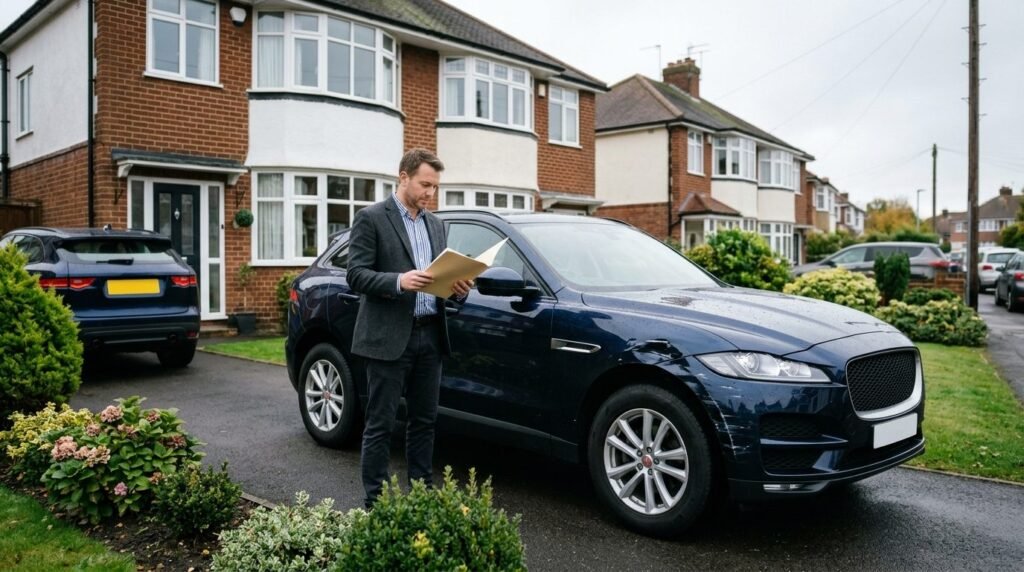
If another driver caused the accident, a lease, PCP or company car is claimed for in much the same way as a car you own outright: their insurer pays for the repair, or the car’s value if it’s written off, and for a replacement car of the same class while yours is off the road. The difference is ownership. The leasing or finance company, or your employer, owns the car, so the money for the car itself goes to them. Your own losses, such as losing the use of the car, your belongings, travel costs and any injury, are yours to claim. National Accident Support Line handles the vehicle side of the claim and the replacement car.
Most drivers find this out the hard way. Someone pulls out on them, and within a week they’re juggling three sets of rules: the lease says use an approved repairer, the finance company wants a settlement figure signed off, the fleet manager has a form to fill in, and nobody has mentioned a car to drive in the meantime. This guide takes each one in turn.
No excess to pay if the accident wasn’t your fault. Fill in our form and we’ll call you back within 2 minutes.
Who owns the car, and who can claim for what
On a lease or PCP you’re the driver, but not the owner. That changes where the money goes, not whether you can claim. The law lets the person who has the car and uses it claim for losing the use of it, even when a finance company owns it, so the replacement car is your claim. The repair or the write-off value is paid for the owner’s benefit.
| The car | Who owns it | Where the money for the car goes | What’s yours to claim |
|---|---|---|---|
| Personal lease (PCH) or contract hire | The leasing company, for the whole agreement | The leasing company | The replacement car, any excess you’ve paid, belongings, travel costs, injury |
| PCP or hire purchase | The finance company, until the last payment | The finance company first; anything left after the finance is cleared comes to you | The same, plus any equity left in the car |
| Company car | Your employer, or its leasing company | Your employer or its leasing company | Your belongings, out-of-pocket costs and any injury. The car and its replacement usually belong to the company’s claim |
| Salary sacrifice car | Usually a leasing company, through your employer’s scheme | The leasing company | Depends on the scheme, which has its own insurance and accident process, so tell the scheme provider too |
There is only one claim for the car. If the leasing company or your employer has already started one for the repair, a second won’t be paid, so find out who has started what first.
Tell the lease or finance company, and follow its accident process
Read the accident section of your agreement. Most say how quickly you have to report an accident and whether repairs need the leasing company’s approval before they start. Some leases include an accident helpline as part of a maintenance package, and a few name an accident management firm you’re meant to use. Report it the way the agreement says, and if it names a provider, tell us on the call so the two don’t overlap.
Tell your own insurer as well. Your policy will almost certainly require you to report any accident, even one you aren’t claiming for. Reporting isn’t claiming: the claim can still go to the other driver’s insurer, which keeps your excess and no-claims discount out of it.
Keep paying the monthly payments. An accident doesn’t normally pause the agreement, even while the car is in the bodyshop, and missed payments go on your credit file whoever caused the crash.
Approved repairers and manufacturer parts
Lease agreements usually say the car must be repaired to the manufacturer’s standards, often at an approved repairer, using genuine parts. That protects the warranty and the car’s value when it goes back. The at-fault insurer has to pay the reasonable cost of putting your car right, and for a newer car under warranty on a lease, that normally means a manufacturer-standard repair. If the other driver’s insurer offers its own repairer or non-genuine parts that would break your lease terms, say so, and get the leasing company’s requirements in writing.
Two more checks. Cameras and radar sensors sit behind bumpers, grilles and windscreens, and after a repair they have to be recalibrated, so ask for the calibration record with the invoice. And at the end of the agreement the car is inspected against the industry’s fair wear and tear standard: accident damage that was left unrepaired, or repaired badly, can be charged to you then, even though the crash wasn’t your fault. Keep the invoice and before and after photos. On our claims, repairs handled from recovery to collection go through our network; tell us on the call what your agreement requires.
If a lease or PCP car is written off
On a lease or PCP the car isn’t yours to keep or buy back as salvage unless the owner agrees. The at-fault insurer pays its pre-accident market value, not what you owe on it; our separate guide covers how the other insurer values a written-off car and how to challenge a low figure.
PCP or hire purchase. The finance company gives a settlement figure, the payout clears it, and anything left over is yours. If the payout is less, the difference is still yours to pay. Your deposit isn’t refunded separately; it’s part of what you’ve already paid towards the car.
Lease. The leasing company sets the payout against its own settlement figure. Any shortfall falls to you, and the initial rental isn’t refunded.
The at-fault insurer doesn’t normally pay that shortfall on top of the car’s value, because it comes from how the car was financed rather than from the crash. That’s the gap GAP insurance is there to fill.
| Type of GAP cover | What it pays |
|---|---|
| Finance GAP | The difference between the payout and what’s left on a PCP or HP agreement |
| Lease GAP (sometimes called contract hire GAP) | The difference between the payout and the leasing company’s settlement figure, usually excluding arrears, excess mileage and the initial rental |
| Return to invoice | The difference between the payout and the car’s original price |
Tell the GAP insurer as soon as the car is declared a write-off, and check what the policy says about a settlement paid by the other driver’s insurer rather than your own. Keep paying until the finance or leasing company confirms in writing that you can stop; payments made after the date of the loss are normally adjusted in the final figures.
The replacement car normally runs until the settlement is paid, though if you could reasonably have replaced the car sooner, the other side can argue it should have ended then. A finance company’s settlement figure can hold things up, so ask for it as soon as you know the car is a total loss.
Company car drivers and fleet managers
Tell your employer or fleet manager straight away and follow the company’s accident procedure, usually in a driver handbook with a number to ring and a report form. The car is on the fleet policy, so your own policy and no-claims discount aren’t involved, though insurers often ask about accidents in any vehicle when you buy your own cover, so answer honestly.
The car and any replacement usually belong to the company’s claim, because it’s the company that has lost the car. Many fleets already have an accident management provider who arranges both, so check before anything else is booked: two replacement cars for the same days won’t both be paid. If there’s no arrangement, or it only offers a small car, a like-for-like replacement can be claimed from the at-fault insurer in the same way, with the company’s agreement.
Your own losses stay yours: damaged belongings, costs you paid yourself, and any injury. If you were hurt driving for work, the injury claim is against the driver who caused the accident, not your employer, and we refer injury claims for drivers hurt in the crash to specialist solicitors. Some employers ask staff to pay towards the excess after an accident; on a claim against the other driver’s insurer, there shouldn’t be one.
Fleet managers can call us about a non-fault accident involving a company car, and we’ll say on the call how it can be handled alongside your fleet insurer and any arrangement you already have. For vans, see a replacement when the vehicle you’ve lost is a van.
A like-for-like replacement while the car is off the road
Leasing or financing a car doesn’t reduce your right to a replacement. If you need a car while yours is repaired or the write-off is settled, the at-fault insurer has to cover one of the same class: the same size, the same number of seats, an automatic if you drive one, electric if that’s what you drive. Through us it’s arranged on credit hire, from a partner network of over 4,000 vehicles across 300-plus models, with the hire charges claimed from the other driver’s insurer at the end of the claim rather than paid by you as you go.
You sign a credit hire agreement, so read it first and ask what you’d owe if fault were disputed later, whether there’s an excess if the hire car is damaged, and who pays for fuel, fines and late return. Our explainer on the hire agreement and the questions to ask before you sign goes through each one. The hire also has to be needed: if there’s a second car at home you could use, or yours is safe to drive until it goes in for repair, say so on the call.
Drivers of newer lease and company cars are often handed a small runaround by their own insurer or the lease company while the repair is done. If the accident wasn’t your fault, you can ask for a car of the same class as yours instead, arranged on credit hire, rather than making do with something smaller for weeks.
If your lease package, your own policy or the other driver’s insurer offers a car, tell us what was offered and for how long. You don’t have to take it, but turning down a suitable car can affect what can be recovered for hire, so it’s worth knowing what a courtesy car from your own policy usually offers first.
No excess to pay if the accident wasn’t your fault. Fill in our form and we’ll call you back within 2 minutes.
Diminution in value, briefly
A newer car that has had serious damage repaired can be worth less than one that hasn’t, and in England and Wales that loss can be claimed in principle. On a lease it’s normally the leasing company’s loss, since the car goes back to them; on PCP it depends on whether you keep the car. It needs an engineer’s report, and is usually only worth raising on a newer, higher-value car with structural damage.
Situations people describe to us
“The lease company says I have to use their accident line”
Check what the agreement actually says. Many only require you to report the accident and have the car repaired to their standard. If yours names a provider for the whole claim, tell us on the call and we’ll say how the replacement can be handled without the two clashing.
“My PCP car’s a write-off and the payout won’t clear the finance”
The shortfall is usually yours unless you have GAP cover, so check the valuation first, because a low offer makes the gap bigger. Get the settlement figure in writing, keep paying until it’s settled, and keep the replacement car until the payout arrives.
“It’s a company car, and my manager says the fleet insurer is dealing with it”
Then the claim for the car is probably already running, so don’t start another. Ask whether a replacement has been arranged and what class it is. Your injury and belongings are still yours to raise.
Frequently asked questions
Who pays for damage to a lease car if the accident wasn’t my fault?
The other driver’s insurer. It pays the reasonable cost of the repair, or the car’s market value if it’s written off, and the money for the car goes to the leasing company because it owns the car.
Do I have to tell my leasing company about a non-fault accident?
Almost always. Most agreements require you to report any accident within a set time and to have repairs approved.
What happens if my PCP car is written off and it wasn’t my fault?
The at-fault insurer pays the car’s pre-accident value, not your finance balance. The finance company is paid its settlement figure first and anything left comes to you. If the payout is short, you owe the difference unless GAP insurance covers it.
Can I get a hire car after an accident in a company car?
Yes, if the car is off the road and a replacement is needed, but it’s usually arranged with or through your employer, since the company has lost the car. Check with your fleet manager so two cars aren’t booked for the same days.
Will a non-fault accident in a company car affect my own insurance?
Your own policy and no-claims discount aren’t used, because the car is on the fleet policy. Insurers may still ask about accidents in any vehicle, so declare it if asked.
How long do I have to make a claim?
In England and Wales, six years from the accident for damage to the car and three years for an injury. Scotland’s time limits are different. The lease or finance company’s reporting deadline is much shorter, so don’t wait.
No excess to pay if the accident wasn’t your fault. Fill in our form and we’ll call you back within 2 minutes.