

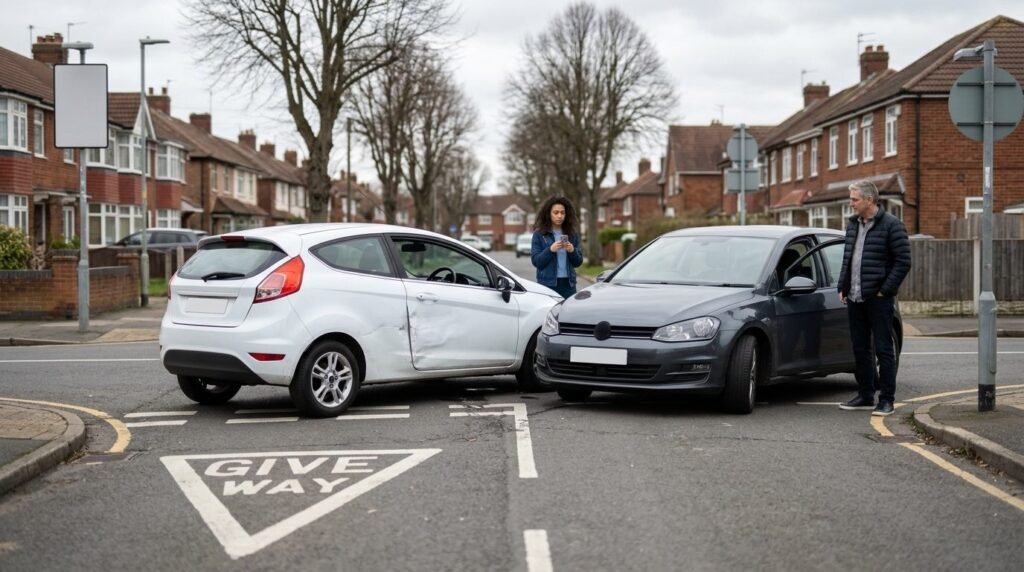
In a side impact or T-bone collision, the driver who should have given way is usually at fault: most often the one who pulled out of a junction, turned across oncoming traffic, went through a red light or changed lanes into you. Insurers judge it against specific Highway Code rules, and the blame can be shared if the other driver was speeding or got something else wrong. If you were hit side-on or t-boned and it wasn’t your fault, the other driver’s insurer should pay for your repair, a replacement car and the other costs you’ve been left with, and National Accident Support Line can handle what you can claim when the other driver caused it, so your own policy isn’t used.
Most side impacts happen at junctions. You’re on the main road, a car noses out of a side road and hits your door before you can react. The other driver says “I didn’t see you”, and a fortnight later their insurer writes to say you were going too fast.
No excess to pay if the accident wasn’t your fault. Fill in our form and we’ll call you back within 2 minutes.
What counts as a side impact or T-bone collision
A side impact is any collision where a vehicle is hit on its side. A T-bone is the classic version: the front of one car goes into the side of another at roughly a right angle, so from above the two cars form a T. It’s typical at T-junctions, crossroads and car park aisles. A sideswipe is the glancing version, where two cars moving side by side scrape along each other, usually when one drifts or changes lanes.
The damage tells part of the story. In a T-bone, the car with front-end damage is usually the one that moved into the other’s path, but not always: if you went through a red light and a car on green drove into your side, you’re the one at fault, even though your car has the side damage. So the damage is the starting point, not the answer.
Who is at fault in a side impact: the usual starting points
There’s no fixed table of fault in England and Wales. Insurers and courts ask which driver failed to take reasonable care, measured against the Highway Code, and section 38(7) of the Road Traffic Act 1988 allows a failure to follow the Code to be used as evidence of fault. These are the usual outcomes, and what moves them.
| Situation | Who usually carries the blame | Highway Code |
|---|---|---|
| A car came out of a side road into you on the main road | The emerging driver, who must give way, including when turning right and crossing your lane. Some blame can move to you if you were speeding or overtaking at the junction | Rules 170 to 172, and 211 for motorcyclists |
| A car turned right across your path into a side road | The turning driver, who should wait for a safe gap in oncoming traffic. It can be shared if you were going far too fast | Rules 179 and 180 |
| Crossroads with traffic lights, a driver went through on red | The driver who went through on red. With no witnesses or footage, two “my light was green” stories often end in a split | Rules 175 and 176 |
| Turning right at lights on green, hit by an oncoming car | Usually the turning driver: green means go only if the way is clear, and oncoming traffic still has priority | Rules 176 and 180 |
| Unmarked crossroads, or lights not working | Nobody has priority, so the blame is often shared unless one driver was clearly going too fast or not looking | Rules 146 and 176 |
| Entering a roundabout and hitting a car already on it | The driver entering, who should give priority to traffic from the right | Rules 185 and 188 |
| On a roundabout, a car cut across your lane to exit | The driver who changed lanes or exited from the wrong lane. Where lane markings are unclear, insurers often split it | Rules 186 and 133 |
| A car changed lanes or merged into your side | The driver who moved across. Joining from a slip road, the driver joining should give way to traffic already on the motorway | Rules 133, 134 and 259 |
| In a car park, a car came out of a bay into you | The driver leaving the bay. If you were both moving, for example both reversing, a split is common | Rules 159 and 202 (applied in car parks too) |
| A car pulled out from the kerb into your side | The driver pulling out, who should check mirrors and blind spot and move off only when it’s safe | Rule 159 |
| You overtook a car that then turned right into you | Often shared: overtaking at a junction goes against the Code, but the turning driver had to check mirrors and signal in good time. The signal and position decide which way it goes | Rules 167, 179 and 180 |
The wording of each rule is in the official Highway Code. Where a rule says MUST, it’s the law; the rest is advice, but a breach of either can count against a driver. Going through a red light is also an offence under section 36 of the Road Traffic Act 1988.
When a car pulls out of a junction and hits you
The starting point is firmly in your favour. A driver coming out of a side road MUST stop at a Stop line and MUST give way at broken white lines (rules 171 and 172), and rule 170 says they shouldn’t join the main road until there’s a gap big enough to do it safely. “I didn’t see you” is an explanation, not a defence, and rule 211 tells drivers to look out for motorcyclists and cyclists, who are easy to miss at junctions.
Their insurer will usually try one of four arguments. Speed: this only shifts blame if you really were going too fast and it made a difference, and telematics or dashcam data often settles it. Your indicator: rule 104 warns drivers that another car’s indicator may not have been cancelled, so the driver pulling out usually keeps most of the blame, though a signal you’d left on can cost you a share. Being flashed out: rule 111 says never assume flashing headlights is an invitation to go, so the emerging driver still had to check. And the gap in a queue: if they came through a gap in stationary traffic while you were passing the queue, it’s often shared, because rule 167 says not to overtake at or approaching a junction.
Shared fault in side impact claims
Being partly to blame doesn’t stop you claiming. The Law Reform (Contributory Negligence) Act 1945 cuts the claim by your share of the blame, so a driver found 20% to blame recovers 80% of their losses. In side impacts the usual reasons for a share are speed, an indicator left on, overtaking near a junction, or both drivers going at an unmarked crossroads.
Not wearing a seatbelt is different: it doesn’t make you responsible for the crash, but it can reduce an injury claim. And where two accounts conflict with no independent evidence, insurers often settle at 50/50, which is recorded against both drivers as a fault claim. Our page on split liability and knock for knock explained covers what that means for your no-claims discount and how to challenge your own insurer before it settles.
No excess to pay if the accident wasn’t your fault. Fill in our form and we’ll call you back within 2 minutes.
The evidence that settles who hit whom
Side impacts happen fast and often out of shot, so collect what you can on the day.
The damage on both cars. Photograph the front of their car and the side of yours, close up and from a distance. The height of the damage, the angle of the dent and the direction of any scrape show which car was moving. A scrape running from front to back along your car points to theirs moving into you.
The scene. The cars’ final positions, photographed before they’re moved if it’s safe, plus debris, the give way or stop lines, signs, the lights and anything that blocked the view, such as a van parked on the corner. Take a photo from the emerging driver’s position too.
Footage and data. A front dashcam may not catch a car coming from the side, but it still records the colour of the lights, your speed and your position. Copy the file off the card before the camera loops over it. Ask nearby shops, buses and homes with doorbell cameras quickly, as many systems overwrite within days or weeks. A black box policy can show your speed and braking at the moment of impact.
Witnesses and the police. Get the name and phone number of every witness. If the police attended, note the reference: in England and Wales, a conviction for careless driving can be used as evidence in the civil claim. If the other driver drove off, see what happens when the driver who hit you didn’t stop.
Write down what the other driver said, with the time, and keep any text where they admit it, but don’t rely on it alone.
If your car isn’t drivable after a side impact
Side impacts often leave a car undrivable even when the damage looks modest. A hit to the wheel can bend the suspension or steering, doors may not shut, and a car whose side or curtain airbags have gone off shouldn’t be driven until it’s repaired. If a door won’t close, the steering pulls or the airbag light is on, have it recovered.
If the accident wasn’t your fault, the other driver’s insurer should cover a replacement while yours is off the road. We arrange it on credit hire: a replacement car of the same size and class, with nothing paid by you at the start, because the hire charges are recovered from the at-fault insurer once the claim is settled. If your car can’t be driven, we aim to have the replacement with you within 48 hours. The credit hire agreement is a form of credit, so read it first and ask what you would owe if the other side later disputed fault, whether the hire car carries an excess, and who pays for fuel, fines and a late return.
If your own insurer has already given you a courtesy car, it’s usually a small one and only for as long as its garage has your car. As long as the accident wasn’t your fault, you can ask for a replacement that matches yours through us instead.
Damage to the door pillars and sills is expensive to put right, so side impacts are written off more often than people expect. If yours is, the hire continues until the write-off is settled; see how the pre-accident value of a written-off car is worked out. If the other insurer offers you one of its own cars, tell us before you turn it down, because refusing a suitable car can reduce the hire charges that can be claimed back.
Injuries from side impacts, briefly
There’s very little between a car door and the person sitting next to it, so side impacts often hurt people more than a shunt at the same speed, especially whoever sits on the side that was hit. Typical injuries are to the head from the window or door pillar, the neck from the sideways jolt, and the shoulder, ribs, pelvis and hip. Get checked the same day, even if you feel fine.
If you were an adult driver or passenger in England or Wales and the crash was on or after 31 May 2021, an injury claim worth up to £5,000 usually goes through the Official Injury Claim service, separately from the claim for the car. We refer injury claims to specialist solicitors: see what to do when a head injury follows a collision, neck injuries that go beyond whiplash or injury claims for drivers and passengers hit side-on. Riders can read about claims for riders hit by a car pulling out.
What drivers tell us after being hit side-on
“My insurer wants to settle it 50/50”
Usually because it’s one account against another. Tell your insurer in writing, before it settles, that you don’t agree, and send it your evidence. Where the crash wasn’t your fault, the claim for your car can go against the other driver’s insurer instead, though you still need to tell your own insurer it happened.
“We’re both insured with the same company”
The same insurer then handles both sides, and with no independent evidence it may propose a split. It still has to weigh the evidence fairly, and if it doesn’t, you can complain and then go to the Financial Ombudsman Service. Send it your photos and footage in writing before anything is agreed.
Frequently asked questions
Who is at fault in a T-bone accident?
Usually the driver whose car hit the other’s side, because they pulled out, turned across traffic or went through a red light. Not always, though: if the car that was hit ran a red light or pulled out itself, its driver can be at fault despite the side damage.
Who is at fault when someone pulls out of a junction?
The driver pulling out, in most cases. They must give way to traffic on the main road and wait for a safe gap (rules 170 to 172). Some blame can move to the main-road driver if they were going too fast or passing other traffic at the junction.
A car pulled out and hit the side of my car. What should I do?
Check everyone is safe, exchange details, photograph both cars and the junction, save your dashcam footage and get witness names. Tell your own insurer it happened; the claim for your car and a replacement can then go to the other driver’s insurer.
Who is at fault in a side impact on a roundabout?
Usually the driver who didn’t give priority to traffic from the right when entering, or who changed lanes or exited from the wrong lane. With unclear markings and no footage, insurers often split it.
Who is at fault if a car pulls out of a parking space into me?
Usually the driver pulling out, who should only move off when it’s safe. If you were both moving, the claim is often split.
What is the time limit for a side impact claim?
Three years from the day of the crash for an injury in England and Wales (for a child, the three years start on their 18th birthday) and six years for the damage to your car. Scotland has different limits. Footage and witnesses disappear long before either deadline.
Can I get a hire car if I was t-boned and it wasn’t my fault?
If someone else caused the crash and you need a car, yes. It should match yours and stay with you until the repair is done or the write-off is paid out, with the hire charges going to the other driver’s insurer.
No excess to pay if the accident wasn’t your fault. Fill in our form and we’ll call you back within 2 minutes.